Gold Hit Rs 572,862 Per Tola in January — Then Fell to Rs 423,000. Should Pakistanis Still Buy It in 2026?
Gold hit an all-time high of Rs 572,862 per tola in January 2026, then fell 26% by July. Yet it still delivered 21% returns for the full fiscal year. Here's what actually happened, what the 25-year data shows, and whether buying at Rs 433,000 today makes sense.

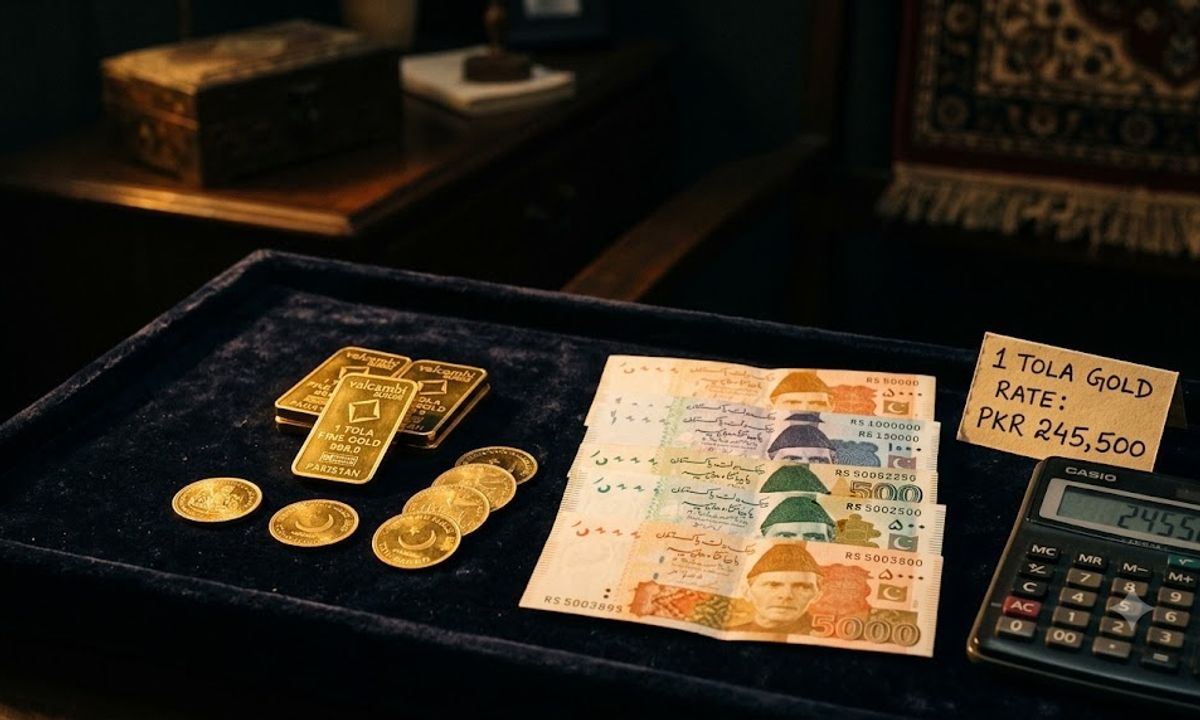
On January 29, 2026, gold hit Rs 572,862 per tola in Pakistan.
The next morning, it fell by Rs 18,000 in a single session.
Over the following five months, gold lost roughly 26% of that peak value, dropping to Rs 423,011 per tola by early July. Along the way, it crossed Rs 500,000, then fell below it. Rallied again. Fell again. By the end of June 2026, the Sarafa Bazar was trading at Rs 424,836.
And yet gold still delivered 21.32% returns for the full fiscal year. From Rs 350,200 per tola in July 2025 to Rs 424,836 by June 30, 2026. One of the strongest annual performances among any major investment class in Pakistan.
That contradiction, a 26% drop from the peak combined with a 21% full-year return, is the most important thing to understand about gold as an investment in Pakistan right now. Because how you read it determines whether buying at Rs 423,000 today is a reasonable decision or a mistake.
What Actually Happened to Gold Prices in FY26
The story of gold in Pakistan during fiscal year 2025-26 has three distinct chapters.
Chapter 1 — The Rally (July to January)
Gold opened FY26 at Rs 350,200 per tola in July 2025. It moved steadily upward through the second half of 2025 before accelerating sharply at the start of 2026. On January 21, it crossed Rs 500,000 per tola for the first time ever. A week later, on January 28, it crossed Rs 550,000. The all-time high came on January 29, Rs 572,862 per tola.
Internationally, gold was trading between $4,800 and $5,300 per ounce at the same time levels driven by global uncertainty, central bank buying, and US dollar weakness.
Chapter 2 — The Crash (January to March)
The day after the all-time high, gold fell Rs 18,000 in a single session. By March 16, it had dropped to Rs 522,762. By the end of March, it sat at Rs 478,762, a decline of nearly Rs 94,000 per tola from the peak in just two months.
This kind of drop of more than 16% in eight weeks is what catches investors who bought near the top. People who purchased at Rs 560,000 in late January were sitting on a loss of over Rs 80,000 per tola by March.
Chapter 3 — The Uneven Recovery (April to June)
Gold rebounded in April, briefly crossing Rs 500,000 again on April 8. The recovery then stalled. Geopolitical tensions from the US-Iran conflict briefly lifted prices to Rs 476,162 in late May. Selling pressure returned through June. The fiscal year ended at Rs 424,836 per tola, down 26% from the January peak but up 21.32% from where it started in July 2025.
Today, July 10, 2026, gold in Pakistan is trading at approximately Rs 433,000 per tola for 24K, according to Karachi Sarafa Association data
Why Gold Fell 26% From Its Peak
Three things happened simultaneously to cause the January-to-June correction.
International gold prices pulled back sharply from their January highs as US Federal Reserve signals suggested rates would stay higher for longer than markets had priced in. International gold dropped from above $5,000 per ounce in January to closer to $4,100 per ounce by July, a significant reversal that directly transmitted to Pakistan's local market.
The rupee held more stable than expected. One of the factors that amplifies gold returns in Pakistan is rupee depreciation against the dollar. When the rupee is falling, gold gains in rupee terms even when international prices are flat. The rupee stayed remarkably stable around Rs 278 per dollar from January through June. That stability removed one of the tailwinds that had pushed gold above Rs 550,000 in the first place.
Profit-taking at historic highs. When gold crosses a record level, investors who bought cheaper start selling to lock in gains. That selling pressure compounds price falls when international markets are also declining.
None of this is unusual. Gold is a volatile asset. The 2013 precedent is worth knowing: gold fell 17% that year globally, dropping from approximately Rs 62,600 to Rs 52,000 per tola in Pakistan. Investors who held through that correction and into 2020 saw gold more than triple.
The 25-Year Picture — What Gold Has Actually Returned
This is where the investment case for gold in Pakistan gets genuinely compelling and where most conversations about gold start getting dishonest by omitting the full picture.
Gold in Pakistan went from Rs 6,150 per tola in 2000 to Rs 424,836 today. That is a 69x increase over 25 years. The compound annual growth rate, the real measure that accounts for compounding, comes out at approximately 18.9% per year in rupee terms, according to data compiled from Karachi Sarafa Association records and news archives.
The historical data in concrete terms:
Sources:
Karachi Sarafa Association records,
If you had invested Rs 100,000 in gold at the 2000 price of Rs 6,150 per tola, buying approximately 16.26 tolas, that holding would be worth approximately Rs 70.4 lakh today at Rs 433,000 per tola. A 70x return in 25 years.
Even a 2020 investment at Rs 100,200 per tola would have grown to approximately Rs 432,000 today, a 4.3x return in five years, or roughly 34% per year compounded.
Gold vs Other Investments in Pakistan — Real Numbers
Pakistan investors have limited options compared to developed markets. Here is how gold stacks up against the realistic alternatives.
Savings accounts: Standard rate roughly 6% annually. With inflation running at 7 to 12% depending on the measure, the real return on a savings account is negative. PKR 100,000 in a savings account in 2020 is worth approximately Rs 134,000 today in nominal terms but buys significantly less in real purchasing power.
National Savings Certificates: Government-guaranteed, currently paying 13 to 15% annually. Better than savings accounts and with zero default risk. But they're denominated in PKR, and 15% on a currency that has lost 81% of its value against the dollar over 25 years is not the protection it appears to be.
KSE-100: Over 25 years, the KSE-100 has slightly outperformed gold in raw returns, approximately 27% CAGR versus gold's 19% CAGR. But this comparison excludes two things: the KSE-100 crashed 62% in a single month in March 2020, and investing in Pakistani equities requires knowledge, an active brokerage account, and ongoing attention. Gold requires none of that.
Fixed deposits: Typically 8 to 15% annually, PKR-denominated, same currency risk as National Savings.
The honest summary: For a Pakistani investor with no investment expertise, a long time horizon, and genuine concern about rupee depreciation, gold has historically delivered better risk-adjusted returns than any of the PKR-denominated alternatives. It's not the highest-returning option. It's the most accessible option with the best track record among those that most Pakistanis can actually access.
Why Gold Returns More in Pakistan Than Internationally
This is the single most important thing a Pakistani investor needs to understand about gold, and it's rarely explained clearly.
International gold has returned approximately 10.9% CAGR in USD terms over the past 25 years. Pakistan gold has returned approximately 18.9% CAGR in PKR terms over the same period.
The gap of roughly 8 percentage points is almost entirely explained by PKR depreciation against the dollar.
Pakistani investors get two sources of return when they hold gold. The first is the international gold price movement, which reflects global supply and demand, central bank buying, and investor sentiment. The second is automatic: when the rupee loses value against the dollar, which it has done at an average of 6 to 8% per year for decades, the PKR price of gold rises by the same amount, even if international gold prices don't move at all.
This means gold in Pakistan is simultaneously an investment in the international gold market and a hedge against rupee depreciation. Both of those have been consistently positive over the past 25 years.
Capital gains on gold are taxable in Pakistan at your applicable income slab rate when you sell. This is the one frequently overlooked cost. If you sell at a profit and your income puts you in the 30% tax bracket, that profit gets taxed. Factor this into net return calculations.
Who Should Buy Gold — And Who Shouldn't
This is where most gold articles become vague. The answer depends entirely on your specific situation.
Gold makes sense if:
You have a long time horizon, five years or more. Gold's short-term volatility is significant. The 26% fall from January's peak to July illustrates what the short-term can look like. Over five-year periods, gold in Pakistan has been positive in almost every rolling window since 2000.
You're concerned about rupee depreciation. If your income is in PKR but your long-term costs include things priced in USD, such as education abroad, medical treatment, and imported goods, gold provides a natural hedge that PKR-denominated savings don't.
You want liquidity without complexity. Gold can be sold at any Sarafa Bazar in any major Pakistani city, usually the same day, without paperwork or brokerage accounts. This accessibility is something no other investment in Pakistan matches.
You're building a diversified portfolio. A 10 to 20% allocation to gold within a portfolio that also includes equities, real estate, or National Savings Certificates reduces overall volatility without significantly dragging on returns.
Gold probably doesn't make sense if:
You need the money within two years. At Rs 433,000 today, you could be buying near a support level, or you could see another correction to Rs 380,000. Nobody knows. Short-term gold positions in Pakistan have historically been unreliable.
You're buying jewelry as an investment. Making charges, typically 8 to 15% of the gold value plus GST, are costs you pay when buying jewelry that you don't recover unless prices rise significantly. Jewelry is for wearing, not for investment returns.
You have high-interest debt. Any debt above 15% annually on credit card balances or personal loans should be cleared before putting money into any investment, including gold. The guaranteed return from eliminating 25% annual interest beats any probable investment return.
You want a dividend or income. Gold produces no yield. It doesn't pay interest. It doesn't generate income while you hold it. If regular cash flow is what you need from savings, gold is the wrong vehicle.
Physical Gold vs Digital Gold — Which Makes Sense Now
This is a newer question in Pakistan's investment landscape and worth addressing directly.
Physical gold coins, bars, or jewelry bought through Sarafa Bazar is the traditional route. You own the actual metal. You can hold it, sell it at any Sarafa market, and it has no counterparty risk. The risks are storage and security: theft, loss, or the cost of a safe or bank locker.
Digital gold through platforms like Oraan or GoldBullion.pk lets you buy any amount, even PKR 1,000 worth, and the platform holds equivalent physical gold in a vault on your behalf. You see the value in an app, sell at current market prices, and the proceeds go to your bank account. No storage risk, no security concern.
For investors with PKR 5,000 to PKR 100,000 to invest in gold, digital gold is the more practical option. The minimum threshold for meaningful physical gold purchase (at least half a tola, roughly Rs 216,000 at current prices) puts it out of reach for smaller investors. Digital gold removes that barrier.
For investors putting PKR 500,000 or more into physical gold bars or coins from a reputable Sarafa dealer, this gives you direct ownership without platform risk. Verify purity certification before any significant purchase.
The Costs Nobody Tells You About
Making charges on jewelry: 8 to 15% of the gold value, sometimes higher for intricate designs. When you sell jewelry back, you receive the gold price; only the making charges are lost. Never count jewelry as an investment.
GST: Applicable on gold purchases in Pakistan. Factor this into your cost basis when calculating actual returns.
Capital gains tax: Profits from gold sales are taxable at your income slab rate. If you're in the 30% bracket and make Rs 100,000 profit on a gold sale, Rs 30,000 goes to tax. The after-tax return matters, not the gross return.
Storage: Physical gold needs either a home safe, bank locker, or insurance. Bank lockers cost Rs 3,000 to 8,000 per year, depending on size and bank. Small but real.
Spread on digital gold platforms: The buy price and sell price on digital gold platforms typically differ by 1 to 3%. Factor this into return calculations for shorter holding periods.
What Analysts Are Saying About H2 2026
Standard Chartered's H2 2026 investment outlook published for UAE and Middle East investors specifically backs gold and global equities as core portfolio drivers. The bank's rationale: continued central bank buying globally, USD weakness expectations, and ongoing geopolitical uncertainty following the US-Iran conflict.
The US-Iran conflict that began in February 2026 disrupted regional markets, including the UAE, and affected Gulf oil exports. Geopolitical uncertainty historically supports gold prices; investors move toward safe-haven assets when political risk increases. The conflict's persistence into H2 2026 is one reason Standard Chartered is maintaining gold in its recommended portfolio.
Pakistan-specific tailwinds for gold in H2 2026: inflation is expected to remain in single to low double digits, lower than FY25 peaks but still enough to erode the real value of PKR savings. The rupee has been stable at around Rs 278 per dollar since January, but analysts warn that any deterioration in Pakistan's external position could pressure the currency, which would push gold prices higher in PKR terms.
Predicting where gold goes from Rs 433,000 is something no credible analyst will do with precision. What they will say is this: the structural reasons Pakistani investors have historically benefited from holding gold, rupee depreciation, inflation, and limited alternative investment options remain in place.
Final Thoughts
Gold fell 26% from its January peak. It still returned 21% for the fiscal year. Both of those facts are true simultaneously, and that's the most honest summary of what gold investment in Pakistan looks like in 2026.
The 25-year track record is real: 18.9% CAGR, consistent outperformance of PKR-denominated savings, and a dual return mechanism that doesn't exist for any other commonly accessible investment in Pakistan.
The risks are also real: significant short-term volatility, no income yield, taxable gains, and the constant possibility of a prolonged correction if international gold prices reverse and the rupee simultaneously strengthens.
For most Pakistani investors with a five-year horizon, some concern about rupee depreciation, and no better use for the capital, a 10 to 20% allocation to gold at Rs 433,000 is a reasonable position. Not because gold is certain to rise. Because the reasons it has consistently risen in Pakistan over 25 years haven't changed.
Buy what you can hold through another 26% correction without being forced to sell. That constraint, more than any price target, should determine how much you put in.
Key Takeaways
- Gold hit an all-time high of Rs 572,862 per tola on January 29, 2026 then fell 26% to Rs 423,011 by early July
- Despite the correction, gold delivered 21.32% returns for the full fiscal year FY26 from Rs 350,200 to Rs 424,836
- Gold in Pakistan has returned approximately 18.9% CAGR over 25 years versus roughly 10.9% CAGR internationally. The 8% gap is explained by PKR depreciation
- Rs 100,000 invested in gold in 2000 would be worth approximately Rs 70 lakh today
- KSE-100 slightly outperformed gold in raw 25-year CAGR (27% vs 19%), but with significantly higher volatility
- Capital gains on gold are taxable at your income slab rate in Pakistan. Factor this into net return calculations
- Making charges on jewelry (8 to 15%) are not recoverable. Jewelry is for wearing, not investing
- Digital gold through platforms like Oraan removes the minimum purchase barrier, accessible from PKR 1,000
- Standard Chartered H2 2026 outlook specifically backs gold as a core portfolio holding for UAE and Middle East investors
- The structural case for gold in Pakistan rupee depreciation, inflation, and limited alternatives remains intact
Frequently asked questions
Is gold a good investment in Pakistan right now in July 2026?+
At Rs 433,000 per tola, gold is approximately 24% below its January 2026 all-time high of Rs 572,862. Whether that represents a buying opportunity depends on your time horizon. For investors with five or more years and genuine concern about rupee depreciation, the 25-year track record supports a measured allocation. For investors needing capital within two years, the short-term volatility makes timing uncertain.
What is the gold price in Pakistan today?+
As of July 10, 2026, 24K gold is trading at approximately Rs 433,000 per tola according to Karachi Sarafa Association rates. Prices update daily based on international gold markets and the USD-PKR exchange rate.
What is the difference between buying gold jewelry and gold bars for investment?+
Jewelry carries making charges of 8 to 15% of the gold value, plus GST. When you sell jewelry, you receive only the gold content price — the making charges are lost. Gold bars and coins carry no making charges and track the gold price directly. For investment purposes, bars and coins are significantly more efficient than jewelry.
Gold vs National Savings Certificates — which is better?+
NSCs currently pay 13 to 15% annually with zero default risk — guaranteed by the Pakistani government. Gold has returned approximately 19% CAGR over 25 years but with significant year-to-year volatility. NSCs make sense for capital preservation with predictable returns. Gold makes sense as a hedge against PKR depreciation and as a portfolio diversifier. Both serve different purposes — a combination of the two is more appropriate than choosing one entirely.
Written by
Umer Khan
Writer/Founder
Umer Khan is the founder and editor of CareerPulse — covering tech careers, remote jobs, scholarships, and personal finance for readers across Pakistan and beyond.
Newsletter
Get smarter about careers every Sunday.
One email, free, unsubscribe anytime. Jobs, scholarships, finance and tech for ambitious readers.