US Bans Anthropic's Most Advanced AI Models for Non-Americans — What Pakistan, India, and UAE Users Need to Know
The US government banned Anthropic's most advanced AI models — Fable 5 and Mythos 5 for all foreign nationals on June 12, 2026. Millions of users in Pakistan, India, and UAE lost access overnight. Here is the full story and what you should do now.

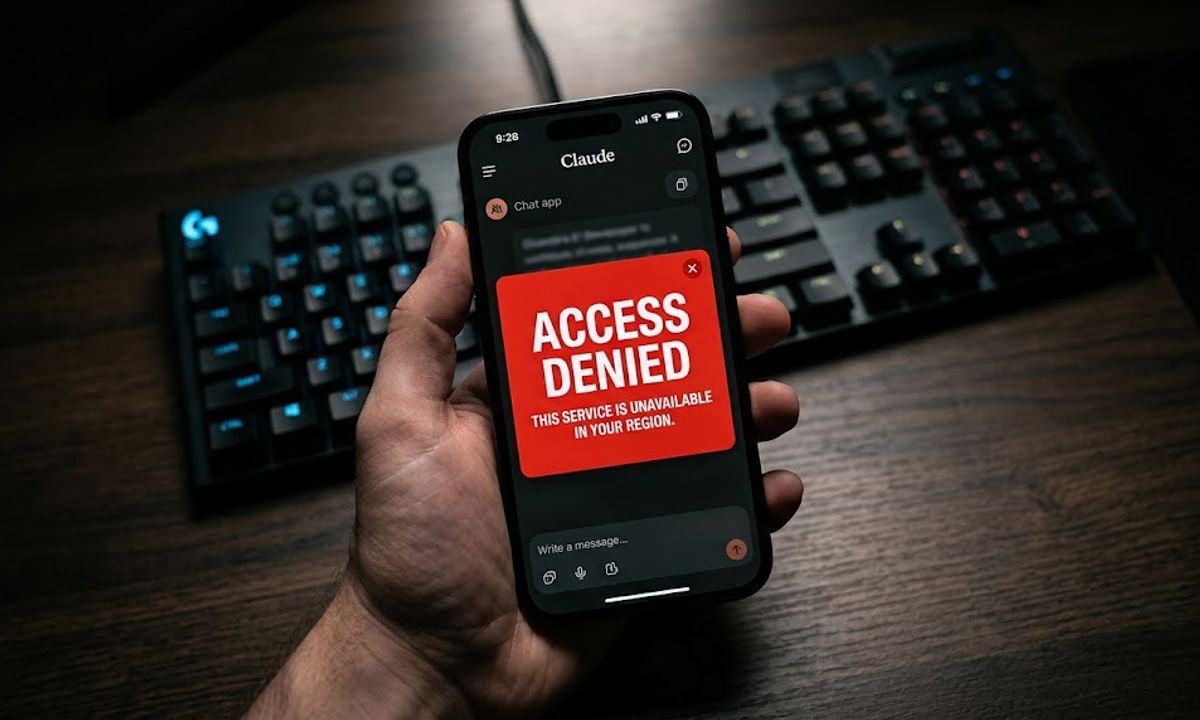
Imagine you are a freelancer in Lahore, a developer in Bangalore, or a content creator in Dubai. You had been using Claude Fable 5 all week. It was fast, sharp, genuinely useful. Then Friday night, you open it and get nothing. No error message explaining why. No warning. Just access denied.
That is exactly what happened to millions of users outside the United States on June 12, 2026.
At 5:21 PM Eastern Time, the US Commerce Department sent Anthropic a letter ordering it to immediately suspend its two most advanced AI models Fable 5 and Mythos 5 for every foreign national on the planet. Anthropic complied within hours. By the end of the night, both models were offline worldwide.
No warning. No appeal. No timeline for restoration.
What Happened — The Full Story
Anthropic launched Fable 5 and Mythos 5 just three days before the ban on June 9, 2026. The company had described these models as its most powerful AI systems ever, the first time it had made a "Mythos-class" model publicly available.
Then came Friday evening.
Commerce Secretary Howard Lutnick sent a letter to Anthropic CEO Dario Amodei. The letter cited national security authorities and ordered the company to suspend all access to both models for "any foreign national, whether inside or outside the United States."
Anthropic published a public statement within hours.
"The net effect of this order is that we must abruptly disable Fable 5 and Mythos 5 for all our customers to ensure compliance," the company said.
The reason Anthropic shut down the models for everyone, not just foreign users is straightforward. The company has no system to verify each user's citizenship in real time. Blocking only foreign nationals was technically impossible on short notice. So it pulled the plug entirely.
Amazon's AWS confirmed the same night that Anthropic had asked it to revoke access "for all users in all regions."
What Are Fable 5 and Mythos 5?
To understand why this matters, you need to understand what these models actually are.
Anthropic built Mythos as a research-grade AI system with capabilities well beyond its consumer products. The company initially said Mythos was too powerful to release publicly and limited it to a small number of vetted organizations through a program called Project Glasswing.
Fable 5 is the public-facing version of Mythos. It uses the same underlying architecture but includes safety classifiers filters that block responses in high-risk areas like cybersecurity and weapons.
Before launch, Anthropic subjected both models to thousands of hours of testing by the US government, the UK AI Security Institute, and third-party organizations. None of those tests found a universal jailbreak.
The models had only been publicly available for 72 hours before they were taken offline.
Why Did the US Government Do This?
The official reason is national security but the details are thin.
Anthropic says the government's letter provided no specific explanation of its security concern. The company's own understanding is that another organization showed government officials a method of jailbreaking Fable 5 specifically, a technique to bypass the filters that prevent the model from helping with cybersecurity attacks.
A US official confirmed that the Commerce Department issued the directive. The specific concern, according to Anthropic, involves a method of prompting the model to identify software vulnerabilities.
Here is the part worth noting: Anthropic says it was given only "verbal evidence of a potential narrow, non-universal jailbreak." Not a documented technical report. Not a reproducible proof. A verbal description.
"We disagree that the finding of a narrow potential jailbreak should be cause for recalling a commercial model deployed to hundreds of millions of people," the company said in its statement.
Experts in the AI security field have noted that models from other major providers including OpenAI's products show similar capabilities to surface minor bugs in code. The question of why Anthropic was singled out is one that several analysts raised publicly on Friday night.
The Jailbreak Claim — What Anthropic Says
Anthropic was direct in pushing back against the rationale.
The company said it believes the government misunderstood the scope of the vulnerability. In its public statement, Anthropic said the alleged jailbreak involved asking the model to read a specific piece of code a narrow, context-specific technique, not a universal bypass.
"If this standard was applied across the industry, we believe it would essentially halt all new model deployments for all frontier model providers," Anthropic said:
The company called the action inconsistent with principles of fair and fact-based regulation principles that Anthropic itself had publicly endorsed just days earlier when calling for greater government oversight of AI.
The irony was not lost on observers: the company had advocated for the government's right to block unsafe AI deployments, then found itself on the receiving end of exactly that authority.
The Pentagon vs Anthropic — A Bigger Fight
Friday's ban did not happen in isolation. It is the latest chapter in a months-long conflict between Anthropic and the US military.
Earlier this year, the Department of Defense wanted to use Anthropic's AI models for domestic surveillance and fully autonomous weapons systems. Anthropic refused. It said those uses crossed the company's ethical red lines.
Defense Secretary Pete Hegseth responded by declaring Anthropic a "supply chain risk to national security" and placing it on a government blacklist set to take full effect later in 2026.
President Trump ordered all federal agencies to stop using Anthropic's products.
Dario Amodei, speaking to CBS News on Saturday morning, was unapologetic.
"We exercised our classic First Amendment rights to speak up and disagree with the government. Disagreeing with the government is the most American thing in the world," He said. "We have stood up for the values of this country."
He also said he would tell Trump directly that he is a "Patriotic American."
What began as a policy disagreement has now escalated into what looks increasingly like a regulatory dispute with commercial consequences. Anthropic confidentially filed for a US IPO last month the ban lands at a particularly sensitive moment for the company's valuation.
What Social Media Said
The reaction online was immediate and divided.
Pentagon CIO Kirsten Davies on X:
"Some things are simply more important than revenue cycles, clickbait, and pre-IPO valuation. America First. Always."
— Kirsten Davies, Chief Information Officer, US Department of Defense
Dean Ball, former White House AI policy official, on X:
"I can't tell if this is lawfare against Anthropic in particular or extreme national-security hawkery. Regardless, it is simply cartoonish."
He added:
"An administration whose posture is that we should export advanced AI chips to China, which also wants to ban Britain and every other non-American on Earth from using our best models? I have no words."
📌 Source: Fortune, June 13, 2026 — fortune.com
Dean Ball also warned:
"This means you should expect to have to prove your citizenship to use Anthropic models."
📌 Source: Reuters, multiple outlets
Gary Marcus, AI researcher and critic, pointed out that the ban would likely push Chinese-born AI researchers currently working at US labs back toward China the opposite of the stated goal of keeping America ahead in AI.
The reaction among tech professionals was largely critical of the government's approach, even among those who agree that AI safety oversight is necessary.
Who Is Affected — Pakistan, India, UAE, and Beyond
If you are reading this from Pakistan, India, the UAE, Saudi Arabia, or anywhere outside the United States the answer is simple: you are affected.
Think about what that actually looks like in practice.
A software developer in Karachi who had integrated Fable 5 into his workflow for code review his pipeline broke overnight. A student in Hyderabad who was using it for research assistance gone without warning. A digital marketing agency in Dubai that had built client deliverables around Fable 5's capabilities suddenly scrambling for alternatives on a Friday night with no notice and no ETA.
These are not edge cases. Anthropic had hundreds of millions of users globally. The majority of them are outside the United States.
The ban covers every foreign national on Earth, including people living inside the US on visa or work permits. It does not matter whether you are a professional in Karachi using Claude for software development, a student in Delhi using it for research, or a freelancer in Dubai using it for client projects.
As of June 13, 2026, Fable 5 and Mythos 5 are inaccessible to you.
What is not affected:
All other Anthropic models remain fully online. This includes Claude Opus 4.8, Claude Sonnet 4.6, Claude Haiku 4.5, and every other model in Anthropic's standard lineup. If you had access to those models before Friday, that access has not changed.
Only Fable 5 and Mythos 5 are blocked.
Anthropic's Own Employees Are Caught in the Middle
One of the stranger dimensions of this story involves Anthropic's own staff.
The government's directive explicitly includes "foreign national Anthropic employees." That means people who work at Anthropic itself, building these models every day, may be unable to access them if they hold a non-US citizenship.
Several of Anthropic's most prominent team members were born outside the United States.
Co-founder Chris Olah is Canadian.
Researcher Andrej Karpathy was born in Slovakia.
Philosopher Amanda Askell was born in the United Kingdom.
Reuters confirmed it could not determine the citizenship status of these individuals. Anthropic declined to comment on whether its own foreign national employees would lose model access.
The image of an AI company being ordered to block its own scientists from using their own product is one that has not gone unnoticed
What Happens Next
Anthropic says it believes the situation is a misunderstanding and is actively working to restore access.
The company has not given a timeline. It has not said what evidence would satisfy the government. It has not confirmed whether negotiations are ongoing.
What is clear is that this marks a new chapter in US AI policy. For years, American export controls on AI focused on chips the hardware that powers these systems. Restricting access to the AI models themselves is a different category of action entirely.
If the standard applied to Anthropic becomes the new norm across the industry, every major AI provider would face the same question: how do you verify citizenship for a web application used by hundreds of millions of people?
That question has no simple answer. And until someone finds one, the precedent set on Friday evening will sit uncomfortably over the entire industry.
What Should You Do Right Now?
If you are a user in Pakistan, India, UAE, or anywhere outside the US, here are practical steps:
1. Switch to available Claude models. Opus 4.8, Sonnet 4.6, and Haiku 4.5 are fully functional. Most everyday tasks writing, research, coding, analysis work well on these models.
2. Explore alternatives for Fable 5-level tasks. Google's Gemini Ultra, OpenAI's GPT-4o, and Meta's Llama models remain accessible internationally. None of them face this specific restriction today.
3. Follow Anthropic's official channels. Updates will be published at anthropic.com. The situation is described as a misunderstanding in the process of being resolved.
4. Do not use unofficial workarounds. VPNs or other methods to circumvent export controls carry legal risk depending on your country's laws. Anthropic has not endorsed any such approach.
5. If you are a developer using the API: Check your existing integrations. Fable 5 and Mythos 5 endpoints are currently returning errors. All other API endpoints remain active.
Summary
The US government ordered Anthropic on June 12, 2026 to suspend its two most advanced AI models Fable 5 and Mythos 5 for all foreign nationals worldwide.
Anthropic complied by disabling the models entirely, since it cannot verify citizenship in real time. The company disputes the rationale, calling it based on a narrow, non-universal jailbreak that does not justify a full withdrawal of a globally deployed product.
The ban is part of a larger conflict between Anthropic and the US military over the use of AI in surveillance and autonomous weapons. It also lands days before what would have been a critical period ahead of the company's planned IPO.
All other Claude models remain available. Anthropic says it is working to restore access.
Key Takeaways
- The US Commerce Department ordered Anthropic to suspend Fable 5 and Mythos 5 for all foreign nationals on June 12, 2026
- Anthropic shut down both models for all users globally, as it cannot filter foreign nationals in real time
- The government cited a jailbreak vulnerability; Anthropic says it is narrow and non-universal
- The ban is part of a broader dispute between Anthropic and the US military
- Claude Opus 4.8, Sonnet 4.6, and Haiku 4.5 remain fully accessible worldwide
- Anthropic says it believes this is a misunderstanding and is working to restore access
- This appears to be the first time a government has forced a publicly deployed frontier AI model offline
Final Thoughts
What stands out most about this entire episode is not the ban itself it’s the speed of it.
A product launched on a Monday. A government letter arrived on Friday. By Saturday morning, hundreds of millions of users worldwide had lost access to something they were actively using with no clear explanation, no timeline, and no real recourse.
Whether you think Anthropic was right to refuse the Pentagon, or whether you believe the government had legitimate security grounds, one thing is hard to argue with: this is not how technology policy should work. Decisions that affect millions of people across dozens of countries deserve more than a Friday evening letter with verbal evidence and a 24-hour compliance window.
The bigger question is not whether Fable 5 comes back online next week. It probably will. The bigger question is what happens the next time a government decides an AI model is a national security risk. Because Friday showed that the infrastructure to pull that trigger exists, it works fast, and the rest of the world has very little say in it.
Frequently asked questions
Is Claude completely blocked for users outside the US?+
No. Only Fable 5 and Mythos 5 are affected. All other Claude models including Opus 4.8, Sonnet 4.6, and Haiku 4.5 remain fully available internationally.
Why did Anthropic disable the models for everyone, not just foreign users?+
Anthropic has no real-time system to verify the citizenship or nationality of its users. To comply with the directive, it had no choice but to disable both models for all customers.
Does this affect Anthropic's API users?+
Yes. Developers who had integrated Fable 5 or Mythos 5 via the API are currently unable to access those models. All other API endpoints remain active.
What are good alternatives to Fable 5 for international users right now?+
Claude Opus 4.8 remains available and is highly capable. OpenAI's GPT-4o, Google's Gemini, and Meta's Llama models are also accessible internationally and unaffected by this directive.
Why did Trump say no more Anthropic?+
President Trump’s opposition to Anthropic stems from a standoff over the military and law enforcement use of Artificial Intelligence
Written by
Umer Khan
Writer/Founder
Umer Khan is the founder and editor of CareerPulse — covering tech careers, remote jobs, scholarships, and personal finance for readers across Pakistan and beyond.
Newsletter
Get smarter about careers every Sunday.
One email, free, unsubscribe anytime. Jobs, scholarships, finance and tech for ambitious readers.